

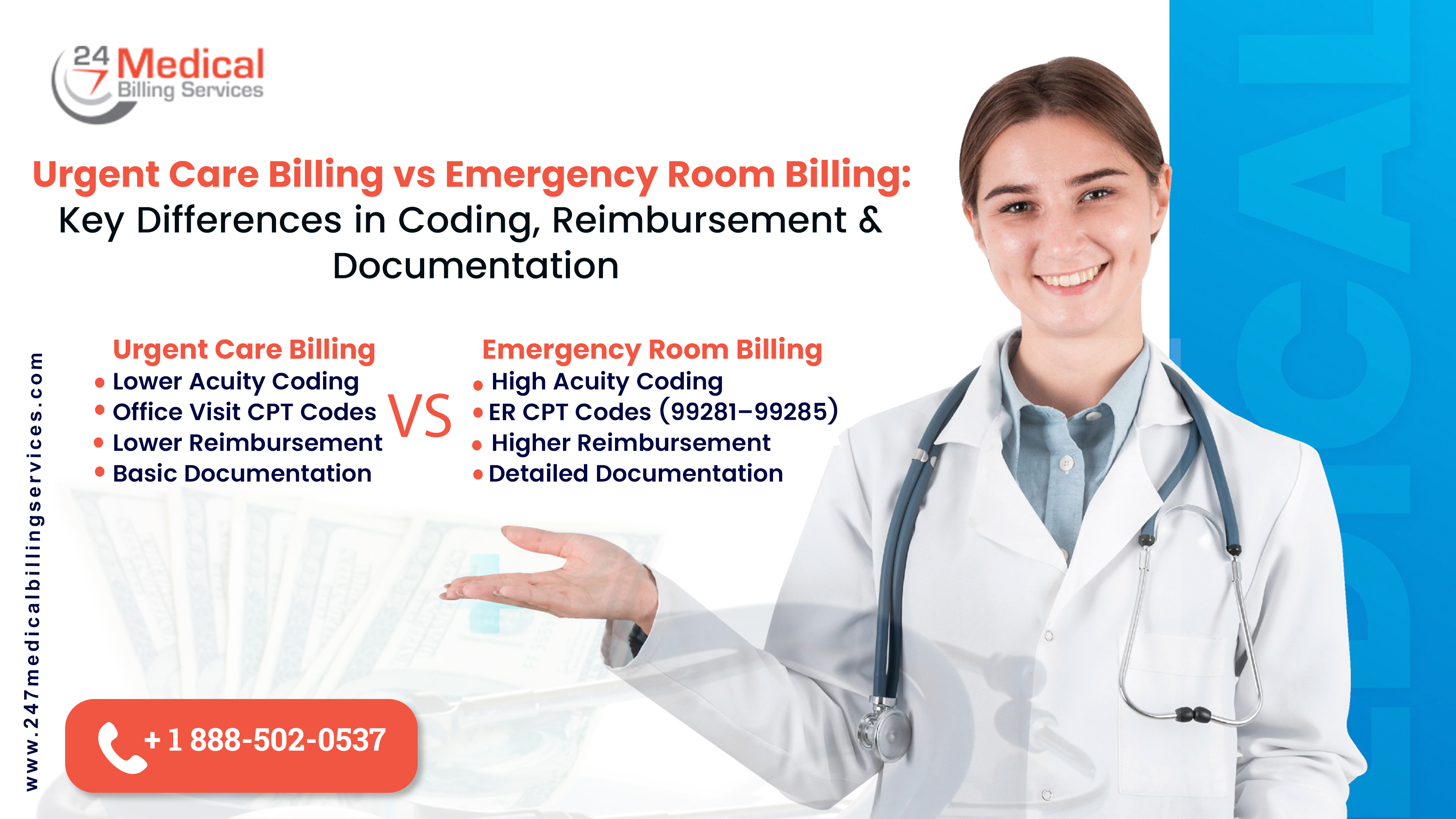
Urgent Care Billing vs Emergency Room Billing: Key Differences in Coding, Reimbursement & Documentation
Have you ever wondered why two patients receiving similar treatment can receive drastically different medical bills?
Why might a minor injury treated at an urgent care center cost around $100–$200, whereas the same visit in an emergency room can exceed $1,200 or even $3,000? These differences are closely tied to how healthcare services are coded, documented, and reimbursed within the medical billing system.
In modern healthcare, billing practices vary significantly depending on the type of facility and the complexity of care delivered. Urgent care centers typically handle non-life-threatening conditions and operate under outpatient billing frameworks, whereas emergency departments manage critical situations and rely on more complex coding structures and facility-based reimbursement models. As healthcare costs continue to rise and payer scrutiny increases, understanding how these two billing systems differ has become increasingly important for providers, billing professionals, and healthcare administrators.
Therefore, a clear understanding of urgent care billing vs emergency room billing is essential for maintaining compliance, preventing claim denials, and ensuring proper reimbursement. This blog explores the key differences in coding guidelines, reimbursement models, and revenue cycle considerations that shape billing processes in both urgent care centers and emergency departments.
Urgent Care Billing vs Emergency Room Billing
Urgent care centers and emergency rooms both provide immediate medical attention, but their billing structures are very different. As a result, billing professionals must clearly understand these distinctions to ensure accurate coding, proper documentation, and correct reimbursement for services rendered.
-
Care Setting and Scope of Services
Urgent care billing applies to services provided for non-life-threatening medical conditions. These centers typically treat minor injuries, infections, or common illnesses. As services are less complex, billing usually follows outpatient guidelines. As a result, documentation and coding requirements are more straightforward compared to emergency departments.
Emergency room billing covers services provided for serious or potentially life-threatening conditions. These facilities operate continuously and are equipped for complex medical interventions. Consequently, billing processes are more detailed and must reflect the intensity of care, the urgency of treatment, and the extensive resources used during patient management.
-
Coding Structure and Evaluation & Management (E/M) Levels
Urgent care providers commonly use standard outpatient Evaluation and Management codes based on medical decision-making and the complexity of treatment. These codes reflect routine clinical encounters. Therefore, coders must carefully document symptoms, assessments, and treatment plans to support the selected billing level.
Emergency department services use specialized evaluation codes that represent increasing levels of clinical severity. Unlike urgent care visits, these codes focus primarily on the complexity of medical decision-making and resource use. Consequently, accurate coding requires detailed documentation describing the patient’s condition and interventions performed during care.
-
Place of Service and Claim Submission
Urgent care claims are generally submitted using professional claim forms that identify the service location as an urgent care facility. This classification informs insurers about the treatment setting. Therefore, accurate place-of-service reporting ensures appropriate reimbursement and reduces the likelihood of claim rejections.
Emergency room services involve both professional and facility billing components. Physicians submit professional claims, whereas hospitals submit institutional claims for facility services. As multiple charges are involved, proper claim submission is essential to ensure that insurers process each component correctly.
-
Documentation and Medical Necessity
Urgent care documentation focuses on the patient’s chief complaint, medical history, examination findings, and treatment plan. Providers must clearly explain why services were necessary. As a result, accurate and concise documentation helps support the chosen evaluation level and prevents claim denials during payer review.
Emergency department documentation must demonstrate the urgency and severity of the patient’s condition. Providers should clearly describe symptoms, clinical assessments, diagnostic testing, and treatment decisions. Consequently, detailed records are essential as insurers often review emergency claims closely to confirm medical necessity.
-
Reimbursement and Payment Structure
Urgent care services usually receive lower reimbursement compared with emergency care. In fact, payments are commonly based on outpatient fee schedules and standard visit codes. Therefore, accurate coding and efficient billing processes are important to maintain steady revenue despite relatively lower payment rates.
Emergency room services typically generate higher reimbursement as hospitals must maintain advanced equipment, specialized staff, and continuous readiness. Payments may include professional and facility charges. Consequently, accurate billing is crucial to ensure providers receive appropriate compensation for the resources used.
-
Insurance Coverage and Payer Policies
Many insurance plans encourage patients to visit urgent care centers for minor health concerns. These visits often require lower copayments and fewer authorization requirements. Therefore, urgent care billing must verify patient coverage and network participation to avoid reimbursement complications.
Emergency services are generally covered by insurance even if the facility is outside the patient’s network. This protection exists as emergency care must be available immediately. However, insurers still review claims to determine whether the visit met emergency care criteria.
-
Patient Cost and Financial Responsibility
Urgent care visits usually involve lower overall costs as services are provided in outpatient settings with fewer resources. In fact, patients often pay a modest copayment. As a result, urgent care facilities are considered a cost-effective option for treating non-emergency medical issues.
Emergency room visits often result in higher medical bills due to facility charges, specialized staff, and extensive diagnostic services. In fact, patients may also face deductibles or coinsurance. Therefore, understanding billing differences helps patients make informed decisions about where to seek care.
-
Compliance and Billing Challenges
Urgent care facilities often face challenges such as incomplete insurance information or incorrect coding levels. Consequently, billing teams must verify patient details and follow coding guidelines carefully. Consistent documentation and claim review processes help reduce denials and improve reimbursement accuracy.
Emergency departments frequently experience compliance scrutiny due to the high cost of services. Insurers may review claims to confirm that billing levels match the complexity of care provided. Therefore, hospitals must maintain strong documentation and coding practices to avoid audits or payment reductions.
-
Revenue Cycle Management Considerations
Urgent care centers rely on efficient revenue cycle processes as they handle large numbers of patients each day. Quick claim submission, accurate coding, and timely denial management help maintain steady cash flow. Therefore, streamlined billing operations are essential for financial stability.
Emergency departments manage more complex claims involving multiple services, procedures, and facility charges. As these claims often require detailed review, hospitals depend on experienced billing teams and advanced systems. Effective revenue cycle management ensures accurate reimbursement and reduces delays in payment.
Conclusion
Understanding the billing distinctions between urgent care centers and emergency departments helps healthcare providers manage claims more accurately and maintain financial stability. As both care settings operate under different clinical demands and payer expectations, billing teams must carefully apply appropriate coding practices and follow payer-specific guidelines to support compliant claim submission.
Furthermore, many healthcare organizations prefer outsourcing medical billing and coding services to the experienced revenue cycle specialists to maintain efficiency and accuracy as billing regulations and payer policies continue to evolve. As a result, 24/7 Medical Billing Services supports providers by improving billing accuracy, strengthening documentation compliance, and optimizing reimbursement outcomes.
FAQs
Why do insurers review emergency room claims more closely than urgent care claims?
As ER services usually involve higher charges and complex treatments, insurers often apply stricter claim reviews and medical necessity checks.
Do urgent care centers charge facility fees like hospitals?
Most urgent care centers do not charge hospital-level facility fees, which is one reason their overall billing amounts are generally lower.
Why do emergency room bills sometimes include multiple providers?
Emergency care may involve several specialists, such as physicians, radiologists, or laboratory professionals, each submitting separate professional claims.
How does patient triage influence emergency room billing?
Triage helps determine the severity of the patient’s condition, which can influence the level of services documented and ultimately billed.
.png)